
 Tools
Tools Tools
Tools


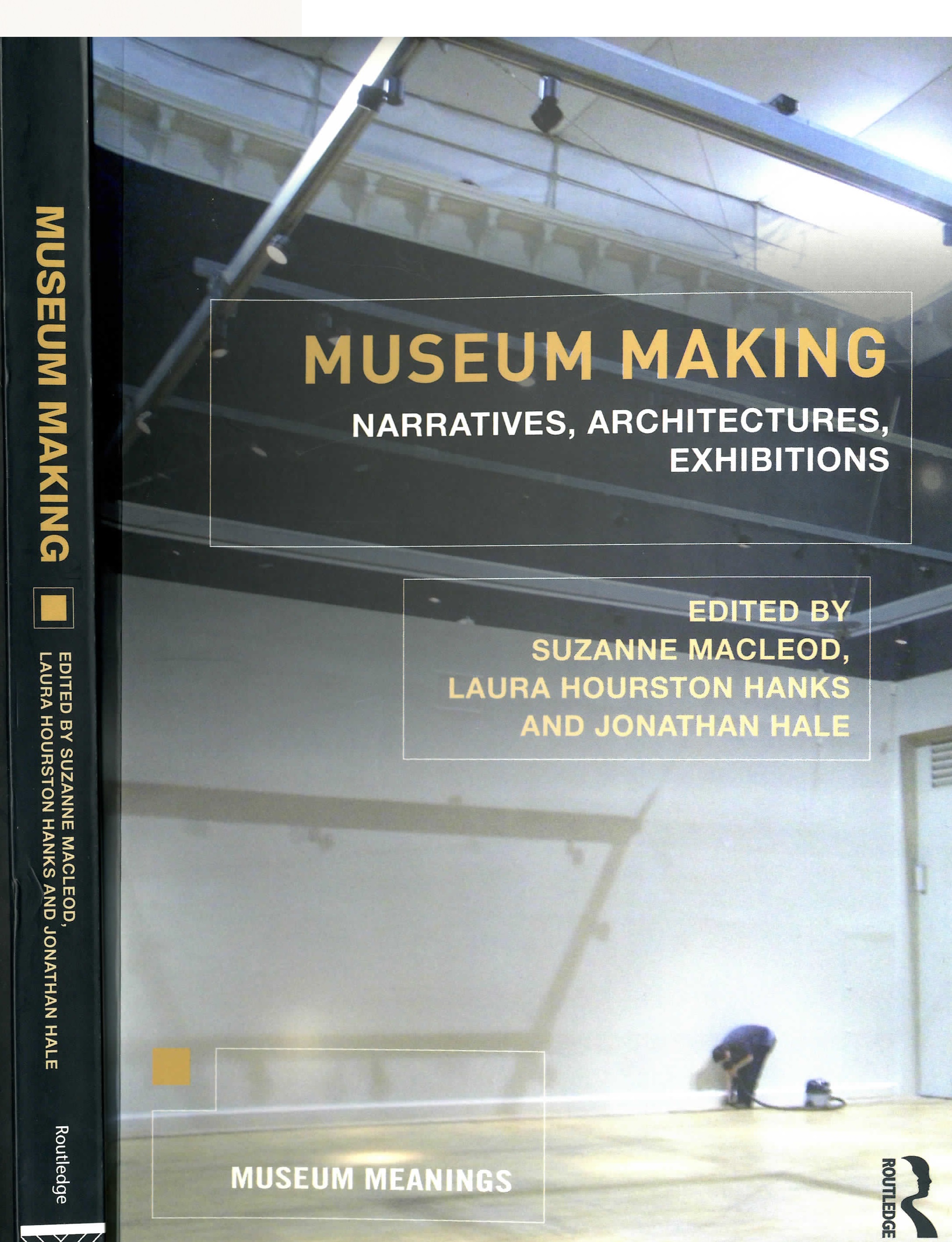
Austin, Patricia (2012) Scales of narrativity. In: Museum Making: Narratives, Architectures, Exhibitions. Museum Meanings . Routledge, Abingdon, Oxon., pp. 107-118. ISBN 9780415676038
![[img]](https://ualresearchonline.arts.ac.uk/3406/1.haslightboxThumbnailVersion/austin_narrativity.jpg)
| Type of Research: | Book Section |
|---|---|
| Creators: | Austin, Patricia |
| Description: | Narrativity, a term that describes the degree of “storyness” of a text, can also be applied to exhibition design, architectural practice, urban and landscape design to provide a useful analytical framework and creative methodologies for collaboration among theorists,content developers, architects and designers. Narrativity can be used to set out an incremental scale of “storyness” inviting discussion of the definition of narrative environments. All spaces can be made to tell a story. For example, sand dunes can tell a story of natural forces, in the forms shaped by wind and sea power, high-rise tower blocks can tell a story of socio-political forces, in the forms shaped by urban concentration, favelas tell a different story of urban development, shaped by dispossession, exhibitions tell stories of peoples’ material From these examples, it can be seen that some environments are more deliberately narrative than others. When does an environment become a narrative environment? A narrativity scale progresses by identifying the narrative features from which powerful story experiences in space can be developed. Thinking of spaces as stories highlights the quality of audience or user experience, the message or content, and the degree of authorship and intentionality in the environment. The telling of the story develops from dramatic tension and its unfolding over space and time is interpreted through visual, audio, olfactory, haptic and tactile senses. Perfomativity, sequencing of events, framing, revealing and concealing, suspense, mimesis, diegesis, closure, focalisation, human and non-human agency all become explicit strategies or devices available to the creative practitioner. The narrativity scale is shown as a diagram and examples, shown through images and video, are mapped onto the diagram. |
| Official Website: | http://www.routledge.com/books/details/9780415676038/ |
| Additional Information (Publicly available): | This chapter is based on a paper presented at Narrative Space, 20-22 April 2010, University of Leicester, School of Museum Studies. This was an international conference exploring the interpretive potential of museum architecture and design. |
| Keywords/subjects not otherwise listed: | Narrativity, narrative environment, methodology, scales, author, telling, story, audience, context |
| Publisher/Broadcaster/Company: | Routledge |
| Your affiliations with UAL: | Colleges > Central Saint Martins |
| Date: | 28 February 2012 |
| Related Websites: | http://www2.le.ac.uk/departments/museumstudies/documents/narrative-space-brochure |
| Related Websites: | |
| Event Location: | Univeristy of Leicester |
| Projects or Series: | Research Outputs Review (April 2010 - April 2011) |
| Date Deposited: | 22 Feb 2012 14:05 |
| Last Modified: | 09 Nov 2023 04:46 |
| Item ID: | 3406 |
| URI: | https://ualresearchonline.arts.ac.uk/id/eprint/3406 |
| Licence: | No Licence |
Repository Staff Only: item control page | University Staff: Request a correction