
 Tools
Tools Tools
Tools


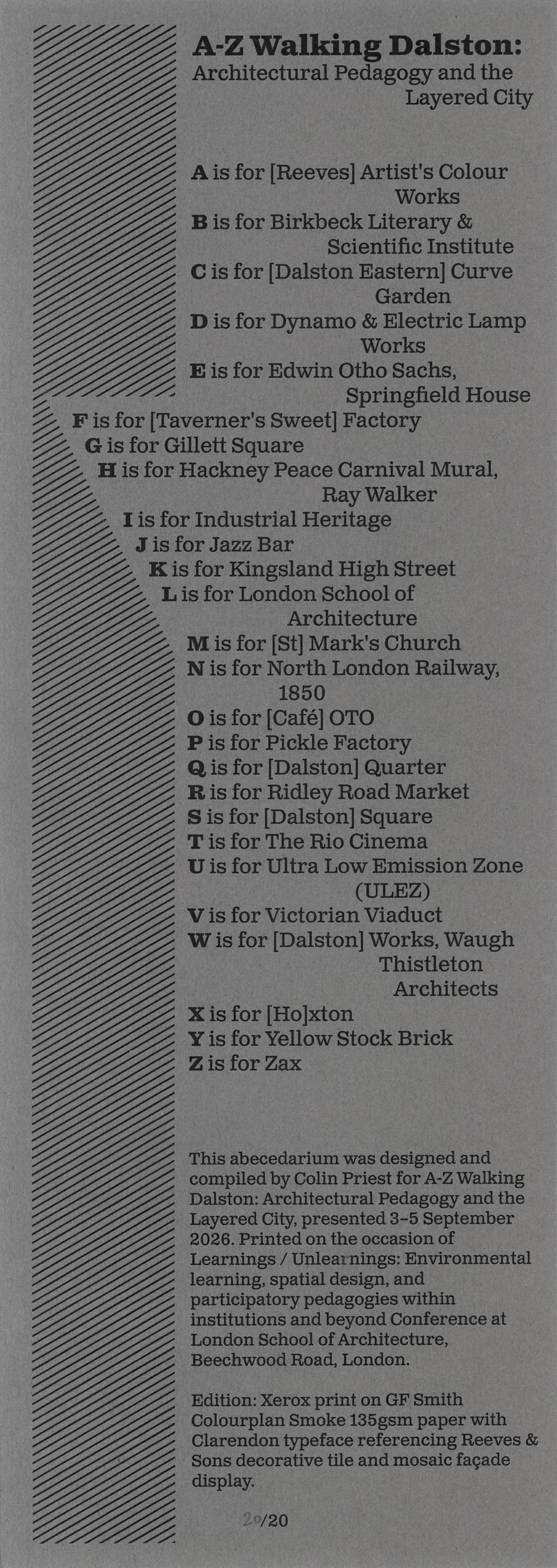
Priest, Colin (2026) A-Z Walking Dalston: Architectural Pedagogy and the Layered City. In: Learnings/Unlearnings: Environmental learning, spatial design, and participatory pedagogies within institutions and beyond, 3-5 September 2026, London School of Architecure.
![[img]](https://ualresearchonline.arts.ac.uk/27885/2.haslightboxThumbnailVersion/A-Z%20Walking%20Dalston_Architectural%20Pedagogy%20and%20the%20Layered%20City_Colin%20Priest_2026.jpeg)

| Type of Research: | Conference, Symposium or Workshop Item |
|---|---|
| Creators: | Priest, Colin |
| Description: | This 75-minute guided architectural walk workshop through Dalston, East London, interrogates how direct engagement with the built environment situates learning beyond institutional boundaries. Departing from and returning to the London School of Architecture, the walk employs an abecedarian - an alphabetical framework inspired by Georges Perec’s (1975) constraint based methodologies - as both navigational device and pedagogical tool to traverse a stratified urban landscape where Victorian civic institutions, industrial heritage, and contemporary mass timber construction converge within a single square mile. Drawing on psycho-geographic methodologies articulated by writers such as Iain Sinclair (2003), the critical urban observation practiced by Ian Nairn (1966), Rebecca Solnit’s (2002) theorization of walking as embodied thinking and civic engagement, Jonathan Meades’ (2012) concept of the city as museum without walls, and Peter Smithson’s Walks within Walls project for Bath (1971), the session frames architecture as lived experience. A site-specific abecedarian structures encounters with anchor sites - from Dalston Eastern Curve Garden’s appropriation of the 1850 North London Railway to Waugh Thistleton’s mass timber Dalston Works, Edwin Otho Sachs’ fire-resistant Springfield House, and the Rio Cinema - enabling participants to encounter built form as constituent elements within ongoing social, economic and cultural narratives. This pedagogical approach foregrounds Edge Conditions and Civic Space as analytical frameworks. At each site, the walk incorporates proximate examples examining how communities have iteratively produced space for learning, assembly and cultural expression: the 1871 Birkbeck Literary & Scientific Institute, Ridley Road Market, Ray Walker’s Hackney Peace Carnival Mural, muf architecture/art’s incremental urban interventions at Gillett Square and Dalston Square, and adaptive reuse of industrial structures. By privileging direct observation, collective discussion and the phenomenological experience of spatial navigation, the walk establishes itself as a critical pedagogical instrument that develops spatial literacy and cultivates meaningful place-based knowledge - reclaiming the street as a fundamental site of collective learning. Strand: civic space and edge conditions |
| Official Website: | https://caravanize.nu/learnings-unlearnings-2026/call-for-abstracts/ |
| Your affiliations with UAL: | Colleges > Camberwell College of Arts |
| Date: | 5 September 2026 |
| Funders: | UAL CCW Research Fund |
| Event Location: | London School of Architecure |
| Date Deposited: | 02 Oct 2026 14:57 |
| Last Modified: | 02 Oct 2026 14:57 |
| Item ID: | 27885 |
| URI: | https://ualresearchonline.arts.ac.uk/id/eprint/27885 |
| Licences: |
Repository Staff Only: item control page | University Staff: Request a correction