
 Tools
Tools Tools
Tools


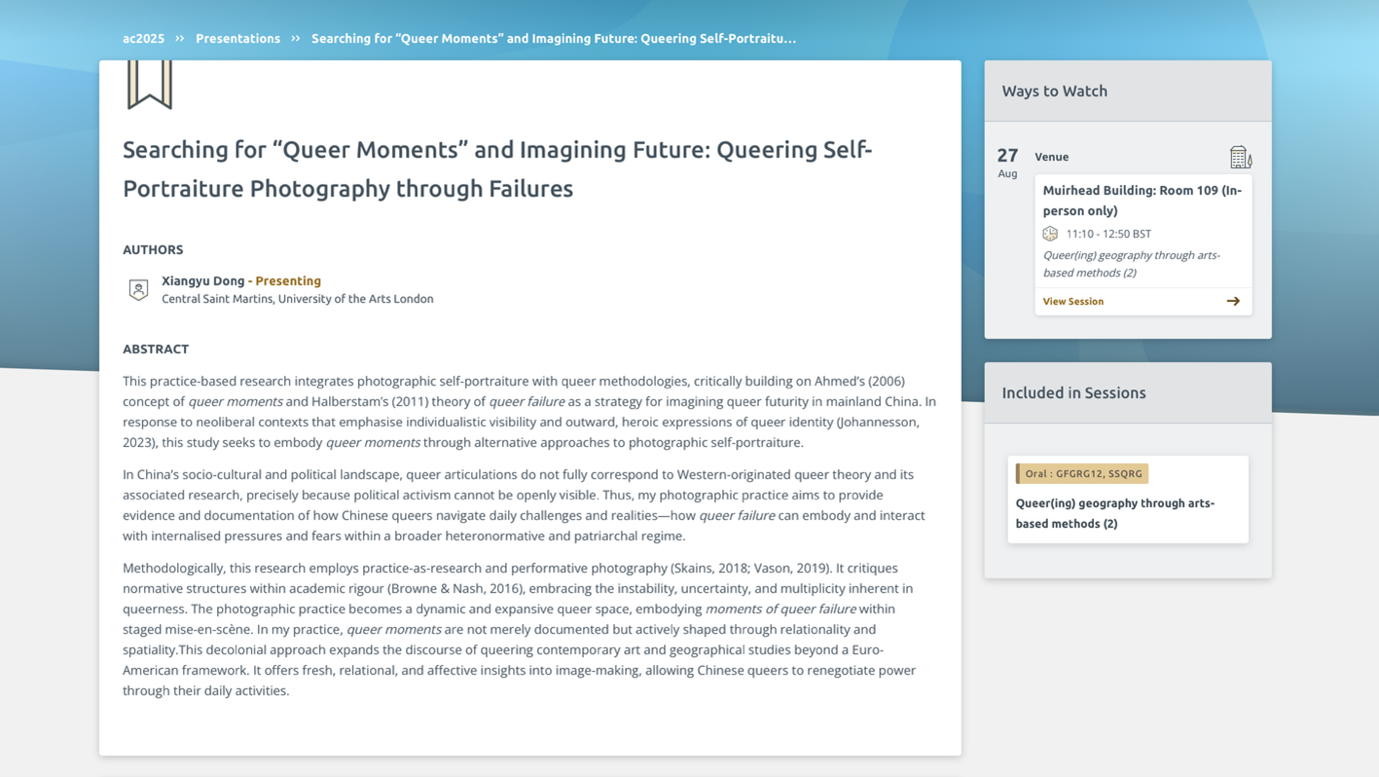
Dong, Xiangyu (2025) Searching for “Queer Moments” and Imagining Future: Queering Self-Portraiture Photography through Failures. In: RGS-IBG Annual International Conference 2025, 26-29 August 2025, University of Birmingham, Birmingham, United Kingdom.
![[img]](https://ualresearchonline.arts.ac.uk/26237/1.haslightboxThumbnailVersion/Picture2.png)
| Type of Research: | Conference, Symposium or Workshop Item |
|---|---|
| Creators: | Dong, Xiangyu |
| Description: | In recent years arts-based methods, as well as queer perspectives, have gained attention within the academic realm and the discipline of geography (Brice 2023; Gieseking, 2023). Nonetheless, examining queer practices and perspectives through arts-based methods is still peripheral to geographical research. Especially in current times, when political and social repression against LGBTIQ+ people is on the rise, it is urgent to do research in novel ways to examine realities and geographies that do not follow the linear development of cis-endo heteronormative life. We need to go beyond conventional approaches to capture and value the complex spatial and emotional relations, structural entanglements, and realities that characterize queer lived realities. Finding ways of (un)doing research means troubling and disrupting binaries, such as mind/body, subjective/objective, research participants/researcher, and the power relations that often go with them. Using arts-based methods in queer geographies allows an exploration of embodied practices and social relations that disrupt the cis-endo heteronormative logics of community, sexual and gender identity, and activities in space and time (Ahmed, 2014; Halberstam, 2005). Arts-based methods allow research participants to portray their place-based perspectives and highlight oftentimes undervalued forms of knowledge. They alter power hierarchies between researcher and researched by questioning the role of the experts and facilitating reciprocity and care (Carpenter, 2022). Besides conventional forms of data dissemination, these methods also allow for creative ways to portray the results in non-academic settings. Within the process of queering geographical research through arts-based methods, a critical engagement with the power dynamics involved in queer realities and research processes is crucial. This means being mindful of our own positionality as researchers, not to (re)appropriate notions of relationality and community, particularly those related to Indigenous, black, and trans practices and histories (Bradway & Freeman, 2022), and paying attention to the accessibility of communities and research processes (Nachman et al., 2023). In this session, we address questions such as: What do arts-based methods, such as creative media practices, dance, photography, creative mapping, collaging, and others, add to queering geographical research? How can arts-based methods portray queer realities that tend to reject rigid categorization without (re)producing binaries? What are the benefits and limitations of a queer approach to arts-based methods? The session includes contributions that engage with arts-based methods and queer(ing) geographies from academic, artistic, practitioners, and other perspectives that seem relevant to the discussions mentioned above. |
| Official Website: | https://conferences.bham.ac.uk/royal-geographical-society-conference-2025/ |
| Your affiliations with UAL: | Colleges > Central Saint Martins |
| Date: | 27 August 2025 |
| Event Location: | University of Birmingham, Birmingham, United Kingdom |
| Date Deposited: | 07 Apr 2026 13:28 |
| Last Modified: | 07 Apr 2026 13:28 |
| Item ID: | 26237 |
| URI: | https://ualresearchonline.arts.ac.uk/id/eprint/26237 |
| Licence: |

|
Repository Staff Only: item control page | University Staff: Request a correction